Interviewing Dan Coxon
Helloooo!
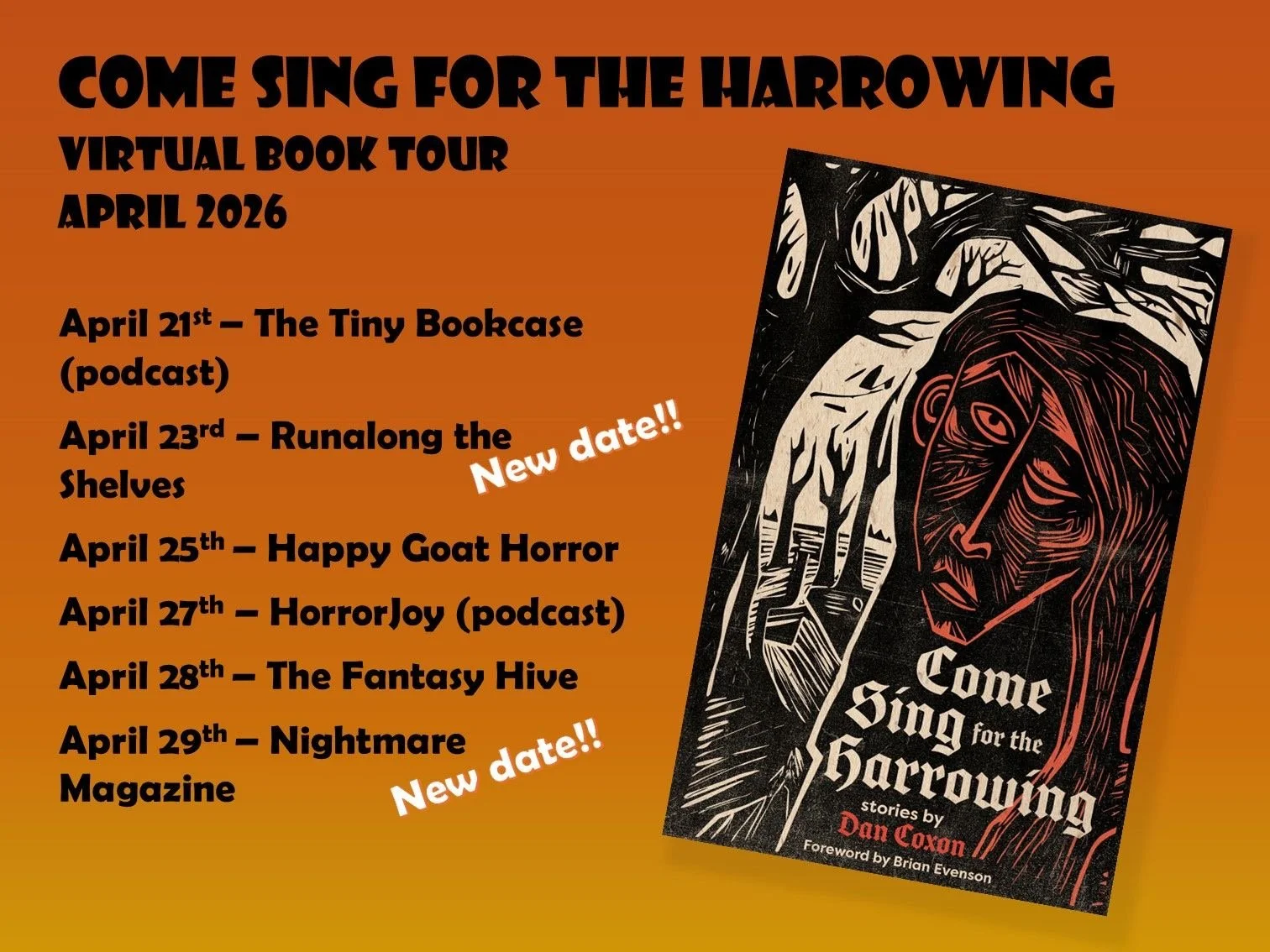
Today I review the excellent Come Sing For The Harrowing: Stories by Dan Coxon a wickedly delicious mix of folk horror and weird fiction I strongly recommend. I’ve been a huge fan of Dan’s work as both and editor and an author i their own right so it was a pleasure to invite Dan back to the blog to discuss this collection and a few other things.
How do you like to booktempt Come Sing for the Harrowing?
It’s a collection of folk-horror stories that aren’t folk-horror stories (or at least not as you’d expect them to be). Part of the initial concept behind Come Sing for the Harrowing was that folk horror feels like a subgenre with a lot of rules and expectations – and I wanted to see what happens when you subvert those. Some of the stories do that more than others, but I think everything in the book in some way plays with the tropes and conventions of folk horror, twisting it into slightly new forms. Sometimes it’s only a little twist; sometimes it’s only marginally folk horror. But that’s the idea.
This collection treads the borders of folk horror and weird fiction what draws you towards those kind of tales?
I’ve been thinking about this a lot recently, and I think one of the things that I love is the kind of story that pulls the rug out from beneath your feet, and makes you realise the world isn’t as stable and predictable as you’d once imagined. Cosmic horror does this too (and there’s at least one story that toys with that in Come Sing for the Harrowing), but I think the Weird and the Uncanny do it particularly well. As for why that appeals, I suspect the times we’re living through have something to do with it. But I also strongly believe that it reminds us of childhood, when everything seems amazing and new, and the world feels big, and dangerous, and inexplicable, but also somehow exciting and filled with wonder. The best stories of this type have a similar effect.
Which was the hardest story in the collection to write and why?
Interestingly, it was one of the most popular stories: ‘The Darkness Below’. This was originally written for Terror Tales of the West Country (ed. Paul Finch), and I just couldn’t get it to behave. I started the story multiple times, tried different viewpoints, cut and rewrote entire sections of it. And then I struggled to get it to end in a satisfactory way, too – it was a struggle from start to finish. I don’t think any of this shows in the finished story, though, and it’s interesting to me that people seem to really connect to it – I suspect I still have PTSD from having wrestled with it for so long, so I can’t see it clearly. I love that my problem child has become so popular, though.
Whose collections do you enjoy reading?
I actually tend to read anthologies more than single-author collections, partly because I’m constantly on the lookout for writers to invite to my own projects. When I do read short story collections, my go-to author is always Robert Aickman, who never ceases to amaze and impress. Among contemporary writers, I love Nathan Ballingrud’s and John Langan’s collections, too. There’s so much exciting work going on at the moment.
Which tale in the collection surprised you the most when writing it?
A couple of them kind of ran away from me, and ended up going to places that I never expected. ‘From the Earth’ was one of those. It was originally written for the Green Ink Sponsored Write, raising money for Macmillan Cancer Support, which meant that I basically wrote 80 per cent of it in a four-to-five-hour period. I had a strong starting idea, and I just let it flow from there. At that point, though, I was slightly unhappy with the way it ended – it felt like it wasn’t quite done with me yet. A few months later I revisited it, and asked the question: ‘What would happen after the events of this story?’ Then I wrote that as a final act, of sorts, to the piece, and I like it so much more now. I don’t want to give away any spoilers, but I think it goes in a pretty unexpected direction, and that was never part of the original concept – it just grew while unattended.
What else can we look forward to from you in the future and where can we find out more?
Oh, I’m so busy this year. Apologies in advance for bombarding everyone with book info over the coming months! I have an anthology coming from Titan Books, Unearthed, which I’ve co-edited with Philip Fracassi. That’s a collection of what we’re calling ‘archaeological horror’ – evil emerging from beneath ancient ruins, including places like Stonehenge and Machu Picchu – and features stories by the likes of Tananarive Due, Eric LaRocca, Christopher Golden, Tim Lebbon, Priya Sharma and many more. Then I have another anthology coming in the same month (September) from Dead Ink Books: Unhallowed Gifts, a sequel-of-sorts to last year’s Unquiet Guests, this time with cursed object stories from Paul Tremblay, Eric LaRocca, Charlie Higson, Evelyn Hollow, John Langan… the list goes on. As for my own writing, I have a novella, Where Once He Stood, coming from Black Shuck Books in May, as well as a single-story chapbook, Never Land, from Salo Press. Busy times.
What great books have you read recently?
Most of my recent reading has been crime novels, as I’ve been a judge for the CWA Gold Dagger for the past two years. We’re still finalising the long- and shortlists, so I can’t say too much – but I did thoroughly enjoy S.A. Cosby’s King of Ashes, which felt Shakespearian in its scope. I’m also doing an event in London on 19th May with Will Maclean and Lucie McKnight Hardy (at Waterstones Islington), and their latest novels, Solace House and Night Babies, are both extraordinary. I’d wholeheartedly recommend them both – or if people are in London, come along and grab a signed copy!