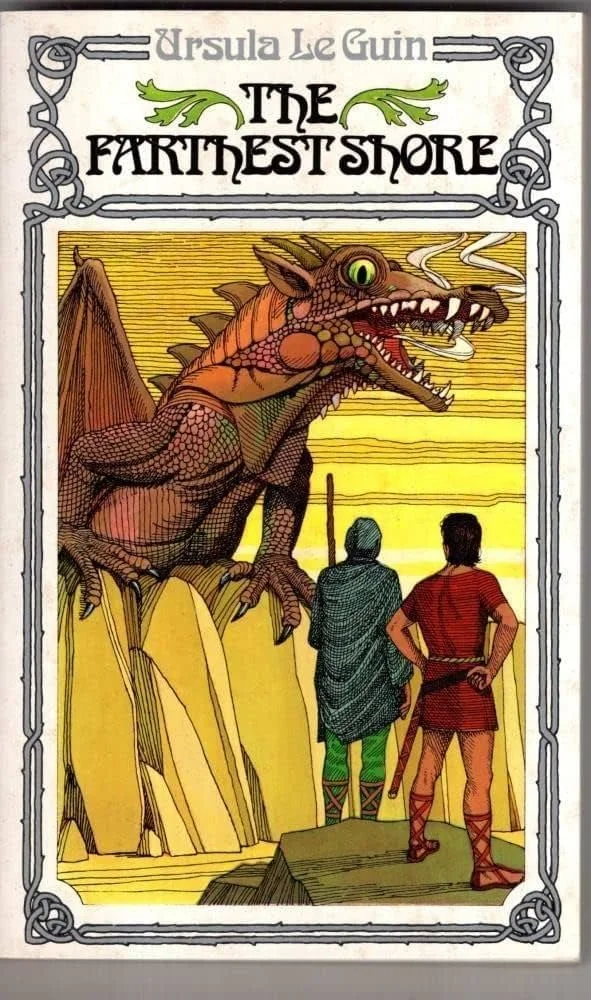
The Farthest Shore by Ursula K Le Guin
First Published – 1972
Evil is at work in Earthsea. Wizards are losing their powers, chanters forgetting their songs, craftsmen no longer using their skills. The equilibrium of the Archipelago is threatened, so Sparrowhawk the Archmage and Prince Arren set out to track the evil. This is the third book in a quartet.
Reading is often a combination of the writer’s words and the reader’s imagination creating the story in their head, but another important factor is timing. I never read Earthsea as a child (I have missed out). I’m reading it as a 49-year-old for the first time and the reason this review is a little late is I read The Farthest Shore Ursula K Le Guin for the first time just as the news broke that the US and Isreal were bombing Iran for variously unclear reasons. Gentle reader that was a reading experience I’ll remember for a long time to come. It’s a curious book in some ways I feel a little dry on occasion but also it has some fantastic themes on ambition, death, letting go and one of those lines about the nature of evil that really makes me think it’s a brilliant piece of writing that I think I appreciate more as an adult than I would have as a youngster.
The third book of Earthsea starts with a notably troubling edge as the islands realise that magic which is so key to this world and the various wizards who look after it appear to be dying. A young prince is sent by his father to Roke to ask the great and good for advice and Arren attracts the attention of Ged the main character we have followed in the previous books. Ged decides to investigate and Arren accompanies him dreaming of victory, but they’ll find the greatest peril, Earthsea has known and both will be changed by the experience.
If a Wiard of Earthsea is about you learning yourself and The Tombs of Atuan is about learning to be who you are and avoid other perceptions then this story for me is underlining the wisdom in learning everything can end and indeed needs to. The overall tone I felt was melancholy. The feeling is that something monstrous and powerful is overwhelming the isles and we see various wizards are losing their magic to such a troubling extent Ged must make one lose all memory of who they were in order that they can live again. In this the relationship of Arren and Ged is I think quite key. Arren is your typical young hero in the making, and a traditional story would p[perhaps have put him to the fore and be the true hero. But Le Guin often makes Arren still a spectator and on the one hand I feel the story is a little passive. We watch things happen to Ged and Arrren and bar a few scrapes Ged is centre and Arren watches. What I liked about Arren is his time with Ged actually shows him that being powerful has a price, that decisions have consequences and sometimes you can’t win. Arren is a very different person at the end. The story leaves him a touch more sombre, a lot wiser about the world and knows that is he follows his father’s footsteps and so becomes a ruler knowing he can’t act rashly. I’m not sure as a teenager, I’d had appreciated how Arren is more a watcher but as an adult I do think he’s more realistic than a few young heroes I’ve read over the years, and the arc is a well told one.
But for me its Ged’s arc that strikes the most. He is notably older again ion this story from the young boy we met two books earlier. He’s in charge but he is clearly weary. He’s the only person who can solve things, but we can sense he feels a little drained by the time he has been in this role. Le Guin neatly builds the tension that death is very much on the agenda as he fights something that is more than the match for him.
Which feels an appropriate time to discuss the threat this book is to face. There is a line early on that is rather gorgeous where Ged talks to Arren about what can cause an imbalance and for Ged that is man with an ‘unmeasured desire for life’ this gets questioned by Arren for being a bad thing to want to live. Ged in response says
“No. But when we crave power over life – endless wealth, unassailable safety, immortality – then desire becomes greed. And if knowledge allies itself to that greed, then becomes evil. Then the balance of the world is swayed, and ruin weighs heavy in the scale”
Try reading that when a world superpower led by a despot starts a war for spurious ideas of safety and by now, we know makes the world worse. But it’s a line you can also apply to Tech bros and corporations and so much more. We tend to think of evil as this cackling dark cloaked menace but here Le Guin says there is usually a motivation and it’s that desire that runs over everything else. I felt was such a lovely piece of writing that I think even Teenage me would have learnt something from it. It also neatly sets up later meeting our actual enemy Cob. A man so afraid of drying and moving on and off the world he has corrupted the entirety of the world to stop it. Again it is hard now not to think of longevity loving billionaires burning up the planet, destroying democracy and promoting hate all to prop their tiny worlds up. Cob’s fear has led him to do what Ged foretold us earlier and the consequences for the finale of the book are marked.
It does take time to get there – we have island hopping, capture and escape that I feel does lack drama, but when we reach the final setting where the borders of life and death come into play there is a deliciously ominous feeling that Ged may finally have met his match. The resolution is where we have person face death and one faces the end of their power. Ged ending this book without magic is here not seen as a loss but more the end of a phase of life that has made him already pay a huge price. He seems released not despondent. Giving up power, accepting that life is finite, passing the baton to the next generation and learning that growing up is not easy are not the lessons we usually get in our younger stories but perhaps we should do this more often.
The Farthest Shore is a fascinating read and I definitely recommend it for having these moments that stand out many decades after it being first written; and as a much older reader than was originally intended it has given me a lot to think about too. A delight of a read!