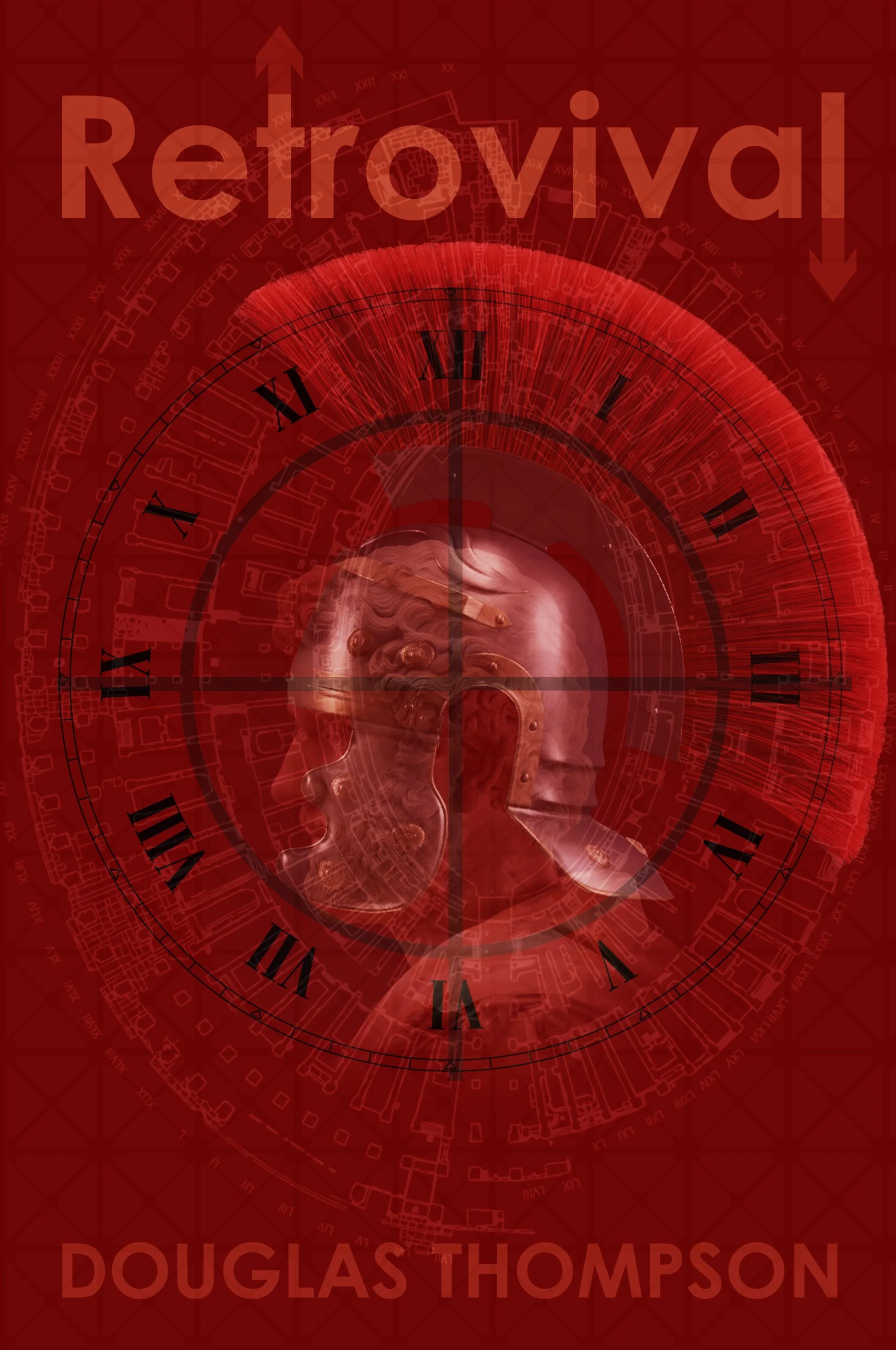
Retrovival by Douglas Thompson
I would like to thank Elsewhen Press for a copy of this novel in exchange for a fair and honest review
Publisher - Elsewhen Press
Published - Out now
Price - £12.99 paperback £2.99 ebook
In a world of the future obsessed with the past, the race is on to resurrect a Roman centurion…
In the year 2089 England has collapsed into a failed state riven by civil war. In neighbouring Scotland a populist demagogue comes to power on a wave of anti-English sentiment, promising to drive out immigrants who have fled from the south. Globally the endless search for mass entertainment has led to an intense fascination with the archaeological past, manifest in interactive simulations of historical eras, which looks set to take on an unwelcome political dimension under the new Scottish leader Fiona Drest.
History lecturer and archaeological consultant Ailee Kenzie is drawn into these events when the body of a Roman soldier is discovered preserved within ancient bog land north of Glasgow. Advanced technology from the Retrovival company can recover fragments of the last experiences held within the dead centurion's brain. Can Caius Flavius’ memories shed light on Britain’s past and the cultural divides that have uncanny parallels in the volatile present?
Dystopian futures and science fiction have long been connected. Indeed we appear to have arrived in one ourselves where too many people have clearly not understood the books saying this is a bad thing. I think the idea of science fiction warning us about futures to prevent is perhaps looking a little weak at the moment but I do think dystopian science fiction can help us understand how people use the tools of power, division and even science to promote harmful agendas. In Douglas Thompson’s interesting novel Retrovival we get a novel very much of ideas positing that dystopias can happen anywhere.
In 2088 Scotland is an independent country. The United Kingdom is no more. England has fallen apart and the Scottish Borders are seeing refugees regularly trying to get into it. However a new untra-nationalist party led by Senator Drest is pushing for a more strident approach to this illegal migration and also wants to start taking back land to protect her borders. At the same time two scientists have found the body of a Roman soldier in a bog and a new science to re-animate the mode of the dead raises new ethical dilemmas and the forces of the press and the police rebuilt in alignment to explore rumours of a much darker agenda to protect Scotland taking place far from prying eyes.
There is a very unusual atmosphere to this book we have some very dreamy sequences where a Roman soldier and a 21st century border guard encounter in other in their dreams. It sets up the story being a series of clashes of ideas. We have ultra nationalists pushing policies we will now see regularly on the news but it feels strange that this is happening on british shores. What Thompson does well is show that a writes of historical and more recent aggressions by the English all help nationalism find the new enemies and permits people to elect politicians to protect them by doing whatever they want. Drest is a fascinating villain and as many remake is playing very much from the dictator’s playbook.
Interestingly science is something she uses too. Here the new Retrovival technology allows dead minds to be reanimated and for archaeologists this could be a holy grail. To see the world as people saw it thousands of years ago but also it asks should we do this can we put a soul back in its body and even if not fully alive is that ok. Science to push how a nation is strong is a reminder that despots use all arms of the world from media, education to force to promote agendas. There is though an intriguing angle that this may ultimately also be Drest’s undoing.
What for me doesn’t work so well is that for a novel of ideas, arguments and illusions it possibly has that front and centre and the characters feel more like they’re moving to give the next debate be it politics or scientific. I’d had appreciated a bit more time for these characters to breathe outside of the drama to see how events are then changing them. As such from our academics falling in love to covert press and police meetings I felt they were all very clearly serving plot rather than feeling like real people I could understand and get to know. A book of arguments is interesting but I think I needed more to get fully invested
I got to appreciate Retrovival but it didn’t fully click with me. My sympathies are very much aligned with the story and it’s a reminder that science should not be beholden to any agenda like this but a bit more storytelling would have made this a stronger story. Still worth a look.