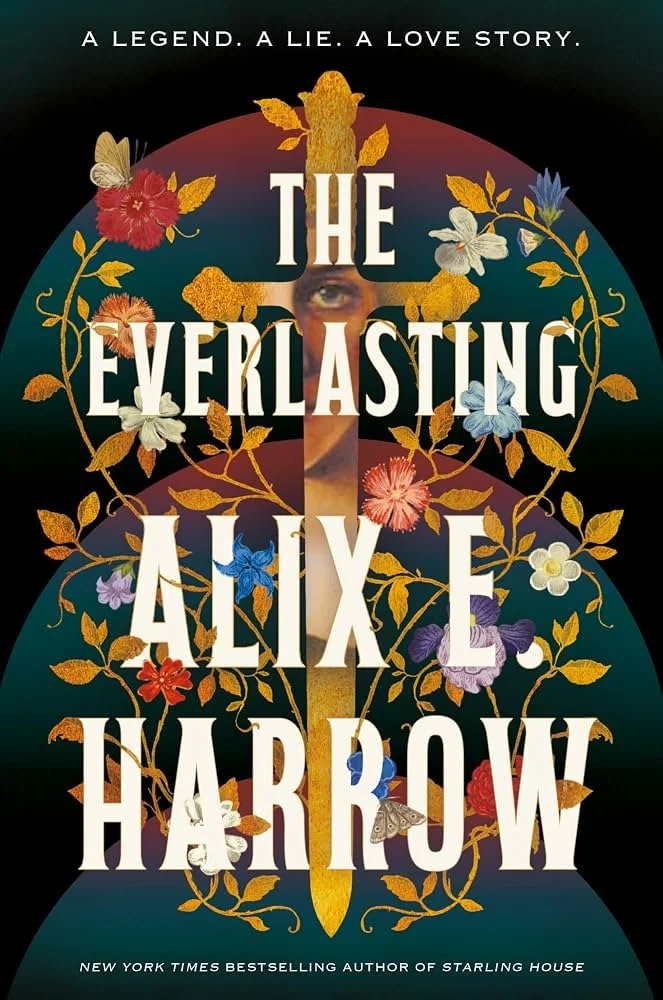
The Everlasting by Alix E Harrow
Publisher - Tor
Published – Out Now
Price – £22 hardback £11.99 ebook
A lady-knight whose legend built a nation meets a retiring historian in awe of her fame. He’s sent back through time to make sure she plays her part . . . even if it breaks his heart.
Sir Una Everlasting was Dominion’s greatest hero: the orphaned girl who became a knight, who died for queen and country. Her legend lives on in songs and stories, in children’s books and recruiting posters – but her life as it truly happened has been forgotten.
Centuries later, Owen Mallory – failed soldier, struggling scholar – falls in love with the tale of Una Everlasting. Her story takes him to war, to the archives, and then into the past itself. Una and Owen are tangled together in time, bound to retell the same story over and over again, no matter what it costs. But that story always ends the same way.
If they want to rewrite Una’s legend, and finally tell a different story, they’ll have to rewrite history itself – and change their lives in the process . . .
Time travel we tend to think automatically as belonging to science fiction but the idea of magical time travel has existed be that falling asleep in the land of the fairies for centuries, Twain’s dabbling with King Arthur or Butler’s excellent and intelligent novel Kindred which holds a mirror into how slavery operated in the US. I was however incredibly disappointed by reading Alix E Harrow’s fantasy novel The Everlasting which on one level is a time gravel romance but ultimately for me tries to import deeper messages that fell quite flat.
Dominion is one of the most powerful nations in the world with a long history of battle and supremacy. One of the country’s most enduring myths is that of Sir Una the Everlasting a knight who fought for her queen underlining the importance of honour, self-sacrifice and the example many use to justify Dominion’s expansion. Owen Mallory has been a soldier and a scholar in Dominion and not quite great at either, but Una’s story has captivated him as a child. After being injured in battle he is recruited by the country’s War Minister to explore a new text. But instead, Owen falls through time and meets Una at the time of her last great act. He knows what must take place but also starts to learn that history is never quite as simple as it seems and time is more malleable than he ever thought possible.
Owen meets Una, falls hard and knows he can’t let events unfurl as planned. In fact, the story’s main act could II think have worked as a cautionary novella ending on a brutal note – does this this perhaps suggest I’m not one for a happy ending or perhaps here I felt the story could make an impact that history is something used by the powerful and can eat us all up. However, there are a lot more chapters to unfurl and one level I can admire how Harrow brings the yearning of Owen into the story and Una is a interesting character who is far more knight than maiden. We have the scholarly reserved Owen with his knowledge and a knight who is much more grounded and earthy (even with a touch of the bawdy). We swap perspectives at times to see the feeling is mutual and as time gets rewritten and re-written we watch the small changes add up and variations of the worlds we know intersect with one another. The rules of time travel are solid and do come together week. Technically I admire it and Harrow’s writing is often lyrical.
I have however several bigger issues that keep getting in the way of me allowing to embrace the story. The core message is about the dangers of history being rewritten for political agendas. Not a message particularly new, but for me the book has a sense of being rather earnest on it as if this is a big statement for the times we live in. But I don’t really buy it as a book for the 2020s. Yes, I could potentially say last century we can see how takes of knights and battles helped perhaps fool people into the horrors of WW1 fighting for honour and country but how many countries now in the west really use their older myths these days for agendas. Harrow is clearly using elements of Arthurian lore – magic swords, knights fighting for their monarch and I just don’t really see this in the world I live in having much wider impact. I would instead argue that current populists are mor likely to focus on more recent battles like WW2 as the myths of how supreme their country is or say that the 1950s were the real Golden Age. Its less populism getting scholars to re-write history these days than governments suing universities or removing funding into areas that challenge them. For me Harrow has a message, but I think its already out of date by several decades. We may feel by the end well they all lived happily ever after but I feel readers are not going equipped to look back at the world they are dealing with fresh eyes.
There are also several character choices that didn’t work. Mallory lets be clear is a willing part of a fascist society. We soon see Dominion is not a good place to live. Secret polices, racism, torture and a desire to conquer and yet Mallory is very loyal to this regime and yet we also see is of mixed race in a world that detests him for his looking different and Harrow doesn’t really explain that loyalty or how it came to pass beyond his fixation with Una’s story – that is rather flimsy and just really a conceit for the plot. In such a world we tend to see its usually quite brutal to those it deems as ‘other’ but instead Owen is allowed in the army and also allowed to be a scholar -that works because the plot requires it but without much interrogation of its actual likelihood in a place where the state is allegedly so powerful and the reaction of most people is to spit on Owen in the street. The slight suggestion is his fractious relationship with his father pushes him to the state that also does not respect him but why? This lack of depth is troubling when such choices are made and not thought through.
The story also seems to give people passes for past actions even when very little to atone for them takes place. The story glosses over that Una was actually in her time quite given to killing people her Queen wanted dead be that enemy warriors or unarmed peasants she just did what she was ordered to. That she shows some brooding on this is enough to let her off. Indeed, ultimately the story suggests simply turning over a new leaf and starting a family with Owen really helps everyone move on…if you don’t notice the pile of bodies that clearly were missed. Without getting too spoiler focused this book has some very odd takes on motherhood. Owen gets a pass for being such a fan of Dominion but never really gets a moment to really say this regime is morally wrong; it comes across far more that the love of his life should not have to die for it if he could have both I’m not sure he’d complain. Owen’s father who perhaps could have saved everyone a lot of pain by simply telling some truths much earlier gets a pass because now he is a drunken revolutionary out of guilt. For me it’s a story that ultimately wants to be a modern fairy tale for adults, thus needs happy endings and gives them without really for me anyone earning them or considering what those rewards mean we are not looking at.
I think fantasy can challenge us and reflect our current times and the issues we are having to deal with them. I think The Everlasting would love to be said to be doing that but for me it shied away from them to the book’s immense detriment and instead tries to be sweet and heart-warming and for me instead feels saccharine and leaves a bad taste in the mouth. I do not recommend this book.