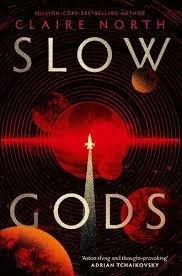
Slow Gods by Claire North
I would like to thank orbit for a copy of this novel in exchange for a fair and honest review
Publisher – Orbit
Published – Out Now
Price –£20 hardback £11.99 ebook
My name is Mawukana na-Vdnaze, and I am a very poor copy of myself.
In telling my story, there are certain things I should perhaps lie about. I should make myself a hero. Pretend I was not used by strangers and gods, did not leave people behind.
Here is one truth: out there in deep-space, in the pilot's chair, I died. And then, I was reborn. I became something not quite human, something that could speak to the infinite dark. And I vowed to become the scourge of the world that wronged me.
This is the story of the supernova event that burned planets and felled civilizations. This is also the story of the many lives I've lived since I died for the first time.
Are you listening?
Science fiction is often seen as the joyful and hopeful glance to the future. That if we use our minds any problem can be solved. It’s a genre that in the last century was often seen as focused on rationality winning the day and many stories and dramas were about how a problem can be ingeniously solved, sometimes with only a few ad breaks to raise the tension. However, a glance at the news suggests that this isn’t really a common human approach. We often seem to struggle with the big problems. In Claire North’s excellent science fiction novel Slow Gods, we actually have a book exploring why we may not solve problems and what it may eventually need us to do to change the status quo and save ourselves.
I’m going to break this book into four segments without spoilers because I think each is quite key to the book’s arguments and how readers can engage with this. The first act while short is going to very much be key to if you click with the book. This is where we meet our main character and narrator Mawukana na-Vdnaze or Maw to everyone else. Maw tells us their life story which includes their events leading to their death and next life. Maw is a citizen from The Shine, a group of worlds very much powered by the economic desire for success and profit. If you are a citizen of the Shine, you immediately come into the world with the debts of being cared for as a unborn child and life gets even harder from then on. Its capitalism on steroids and very much has no time for those it deems under-achieving. Maw is however a fairly simple and unremarkable man whose skills in science mean little economic value is likely and so ends up in a traffic control route and would likely be where he’d stayed bar an event that changes the galaxy.
A mysterious ancient and powerful AI known only as the Slow appears in Space across many worlds and announces that in a little over 100 years a nearby binary star system will go supernova and the resulting radiation wave will wipe out all the worlds being talked to. The death toll will be billions and billions across light years of space. The Shine destroys the Slow’s message devices but not before a few people hear it, uprisings begin and are utterly destroyed. Maw though is simply in the wrong place at the wrong time and ends up arrested, immediately tried and becomes a prisoner who after one injury too many is sent to pilot a starship – a process that effectively lobotomises most humans after the first run or so. Maw’s ship though vanishes, arrives just before it left and everyone on board it is dead bar Maw. Maw leaves the Shine but is now warily viewed by the rest of the universe
All of this unfolds in just the first few chapters but they’re critical to the story. Maw is wonderfully low-key as a narrator. He has humour, little ego and is a genuine everyday person. I like being in their company and hearing their thoughts and puzzlement as to how they got here. More a watcher than active participant and yet he carries sense a mystery about him. We also note all those around him (they’d not say guarding) are nervous if he gets excited. On top of that we now have a big dramatic problem to solve, an evil empire and ancient intelligences being textbook enigmatic as to what they’re up to. In some ways this is classic space opera and yet as this story now unfolds it is going to do things a little differently.
Our first act after Maw’s new life starts is focused on another world that got the Slow’s message. And decided to try and do something about it. There is though no 45 minute handwavium solution for the people of Adjumir. They instead came up with a 100-year plan. This is huge world changing work and Maw describes the power of big decisions, huge arcships, massive resettlement programs and North makes us appreciate the scale – literally we can feel the billions of lives in the balance here as a world is desperately trying to beat the clock. What North does underline is there is no perfect solution either – there will be a significant number of people born over the next century, needed to help build the and support the escape plan who will die without a chance to leave their world. To help put a face to this quandary Maw pilots vessels to this world but strikes up a friendship and perhaps more with Gebre an archivist who seek’s Maw’s help and Maw is fascinated by ter approach and desire to put objects above even their own survival. Compared to the Shine’s focus on the individual worth here a society looks beyond their lives to the whole
Using Maw’s subtle narration this story raises all sorts of parallels with recent events. How people on one level are horrified by the idea of mass loss of life and yet when it requires action or support at the level of accepting people from other worlds you suddenly see the backsliding. A key theme is ultimately people just see Adjumir as a bunch of aliens even in a friendly galaxy and while the people do so much right you can sense over time other problems get in the way for the rest and it falls down news agendas. What I think North does though is help us understand people different to our own – genders here are a multitude, some life is artificial in origin, cultures and traditions are different and yet North makes us see through Maw’s eyes the beauty in this world and wider universe of cultures, these people and that importantly they have a value by being just part of the universe. We will see the cataclysm in this section but are gently reminded this is but one of many worlds that this supernovae is bearing down on. The big question this leaves is will we do better next time? This section haunts me still days after reading it because it reminds me there is a human being in every drama whose life is being torn apart and is a magnificent read.
The next section starts almost as you would expect a standard space opera with a revenge narrative to go. The Shine desperate to replace the worlds they are going to lose decide to occupy their less advanced neighbours and Maw ends up part of a distance group of pilots ferrying weapons for the war on that planet’s struggle for freedom. But here I think is where North moves away from the normal kind of story. Maw is definitely not the future resistance leader against the people responsible for his first death. Maw is kind, has a reason to support the resistance but he is just a pilot with an uncanny ability o get through space. Here instead North examines a more challenging question. Why are the Shine allowed to do this?
The Shine is a society happily lying to its populace about a scientifically provable disaster as it would cost too much in their view to stop. They are more than happy to not follow the protocols of the wider galactic community and indeed seem happy to insult their hosts, ignore the rules and do what they damn well want even conquer other worlds with spurious claims. Got to admit this in no way at all sounds familiar does it….ahem (nb this was published last year). North asks how do we let them get away with it? It is not that we lack plucky heroes, brave plans and speeches. It that The Shine is very wealthy, large and also themselves have a host of deadly weapons they will turn on their neighbours in a heartbeat if they feel threatened. It is so refreshing to have a story explore the realpolitik of a problem and while this may not be feelgood handwavium its has refreshing honesty that somethings cannot be changed quickly or via one man making a difference. Again, parallels with our world are made and indeed there may be a solution. One that has been carefully knitted into all the acts prior. It not simple, its not easy, it involves multiple people working together some aware and some not plus there is a cost for the people acting and North also makes us see the cost of what those actions require to succeed for the unwitting billions affected. A dark echo of the earlier act is making us realise that this omelette’s eggs do contain blood when smashed. There are good reasons why easy solutions don’t often exist and the consequences are never straightforward, ethically clean but the overall message is that sometimes to win we need to find a way to destroy the hegemony in charge is a powerful thought-provoking one and the way this one arrives is a deliciously smart piece of plotting.
But plot is just part of why this story wins me over. The way Maw tells the story is beautiful as we have little insights, and anecdotes from the many strange and wonderful worlds and peoples across this universe to commentary on gender and why it is not that hard a subject to understand. Why helping and apologising are two very different things, why small talk is painful for many, why business plans are more likely to destroy your life more than most conspiracy theories and most of all that we matter as individuals not as a unit of economic value. Maw has heart and passion for us even as an outsider and this book makes us see the whole rather than just a bunch of plucky individuals.
Slow Gods was a brilliant reading experience. I found myself taking my time digesting scenes, the commentary and the unfolding events far more slowly than usual and this was not a painful experience but a helpful one in a year of constant strange events like this one is proving to be. It helped the contemplation of the ideas and arguments being explored here and after reading this I find myself coming back to it in my thoughts a lot. It fits among a recent trend in science fiction wondering what may be next after an Empire or social period like our own falls and importantly suggests some hope can be found. It is a beautiful read, and I very strongly recommend this to you!