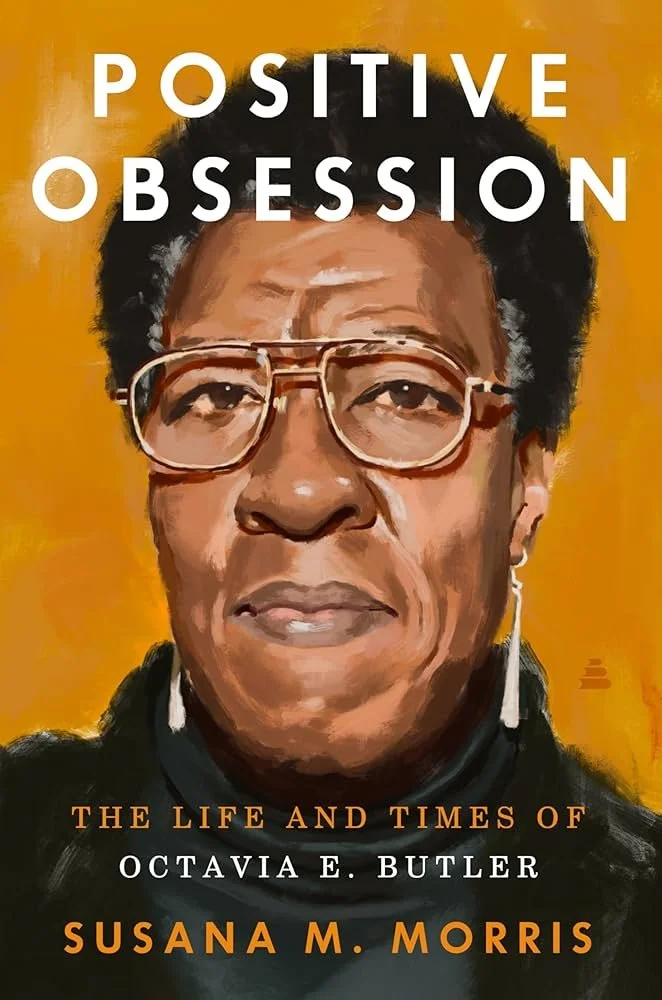
Positive Obsession - The Life And Times of Octavia E Butler by Susana M Morris
Publisher – Amistad
Published – Out Now
Price – £22 hardback £11.99 ebook
As the first Black woman to consistently write and publish in the field of science fiction, Octavia Butler was a trailblazer. With her deft pen, she created stories speculating the devolution of the American empire, using it as an apt metaphor for the best and worst of humanity—our innovation and ingenuity, our naked greed and ambition, our propensity for violence and hierarchy. Her fiction charts the rise and fall of the American project—the nation’s transformation from a provincial backwater to a capitalist juggernaut—made possible by chattel slavery—to a bloated imperialist superpower on the verge of implosion.
In this outstanding work, Susana M. Morris places Butler’s story firmly within the cultural, social, and historical context that shaped her life: the Civil Rights Movement, Black Power, women’s liberation, queer rights, Reaganomics. Morris reveals how these influences profoundly impacted Butler’s personal and intellectual trajectory and shaped the ideas central to her writing. Her cautionary tales warn us about succumbing to fascism, gender-based violence, and climate chaos while offering alternate paradigms to religion, family, and understanding our relationships to ourselves. Butler envisioned futures with Black women at the center, raising our awareness of how those who are often dismissed have the knowledge to shift the landscape of our world. But her characters are no magical martyrs, they are tough, flawed, intelligent, and complicated, a reflection of Butler’s stories.
Morris explains what drove Butler: She wrote because she felt she must. “Who was I anyway? Why should anyone pay attention to what I had to say? Did I have anything to say? I was writing science fiction and fantasy, for God’s sake. At that time nearly all professional science-fiction writers were white men. As much as I loved science fiction and fantasy, what was I doing? Well, whatever it was, I couldn’t stop. Positive obsession is about not being able to stop just because you’re afraid and full of doubts. Positive obsession is dangerous. It’s about not being able to stop at all.”
One of my most fun blog projects was deciding to read Octavia E Butler’s novels for the first time in publication order. They were a gap in my reading history but also its fascinating to watch ana author evolve over around 30 years. There are themes and structures you notice recur and evolve. I didn’t chime with every single book but most of them were knock out reads and in science fiction the Xenogenesis and Parables sequences will stay with me for a very long time. In fantasy (yes totally is) Kindred is a powerful haunting read. It does raise the question who was this woman who seems to have had a huge insight into where the 21st century was heading? In Susana M Morris’ biography Positive Obsession – The life and Times of Octavia E Butler we are shown how Butler became a writer and the highs of low-points of her career.
I hugely enjoyed this book, and Morris is great putting Butler’s work into some context of not just her own experiences as a working-class Black woman growing up in the 1950s and 60s of the United States. Morris reminds us that growing up she will have had relatives with experiences of the 19th century who remember slavery and the post-Emancipation period which also installed inequality. A love of science fiction and writing developed despite Octavia also living on the breadline and while many contemporaries were university educated, we find Octavia juggling jobs, writing and trying hard to get published. Morris really makes this period come alive and start to feed into the novels.
Once we reach the seventies Morris takes an approach to link particular novel sequences to the periods of Octavia’s life. Starting with Butler’s fascination with social structures and evolution we get the recurring theme of where humanity is heading. Getting stronger an author then moves into Kindred where there is a fascinating explanation of how this story came about when a Black friend of hers was angry at how his ancestors had calmly accepted being slaves and instead Butler wanted to explain that in reality there was no choice and the true horror of what happened daily was often not understood. This really opens up a key theme of the book that Butler was a huge researcher – a devoted library goer and in later years very happy to travel to locations to understand a place, its history and how it worked. Morris mentions later on that in reality the non-university educated Butler could easily be said to have gained the equivalent of multiple PHDs in pursuit of the material she needed for a story. The Xenogenesis sequence involved trips to South and central America to help create the settings
I found Morris also has some fascinating insights we overlook. While much is made of Butler’s prescient forecasting of the UK becoming prone to right-wing evangelical control and in particular a leader claiming ‘Make America Great Again’ there is some actual real history that in Ronald Regan who Butler had ha d a long distrust of used a similar slogan ‘Lets Make America Great Again’. This reminds us great science fiction uses the current world to create the futures it shows and clearly Butler saw that this group that was in power could only evolve into something even more toxic than it was already and Morris reminds us this was not an ideal period and simply this is not that unexpected. Is the period we are in an aberration or just a continuation of something that has been ruining the country for many decades?
For each book we also get some really good lengthy in depth exploration of the books with this added context. Morris teaches Butler to students and having that insight as well as the reactions of students to Butler are really bringing the stories to life and explain why unlike some older Golden age writers Butler feels quite fresh and relevant.
Butler is a fascinating opaque figure. A Black woman struggling into publishing, constantly often battling money issues while trying to balance day jobs and writing and always not quite fitting in. A sense of loneliness comes across that although quite introverted the six-foot-tall Butler also never quite found her own groups to mix with but that does get easier with time. I’d liked a bit more about his side of the author and while writing by definition is quite a solitary profession with people at typewriters and later PCs I would have loved to know what Butler was doing at her teaching classes and conventions bit more than this delves into. The horrific writer’s block Butler suffered is well handled and the tragedy of a premature death not helped by medications and many health conditions getting worse What Butler would have had to say over the last couple fo decades is something I feel we have lost out hugely on.
If I have one issue with eh book is that is perhaps a little too pacy. Major periods tend to be just covered chapters and at times it feels quite breezy. While we do get regular excerpts from Butler’s diaries, they do feel slightly truncated glimpses as to what Butler was doing. There are probably three much bigger books you could spin on these even deeper dives into Butler’s works, a more in-depth look at her novels and the history of Black SFF authors in the 20th century. However, each of these subjects would be huge times in themselves and this book for me has a great balancing act of these elements and certainly gives me a greater appreciation for butler than I’d already had. If you’re a fan of Butler’s work then this is highly recommended reading and a fascinating insight into an awesome writer’s life.