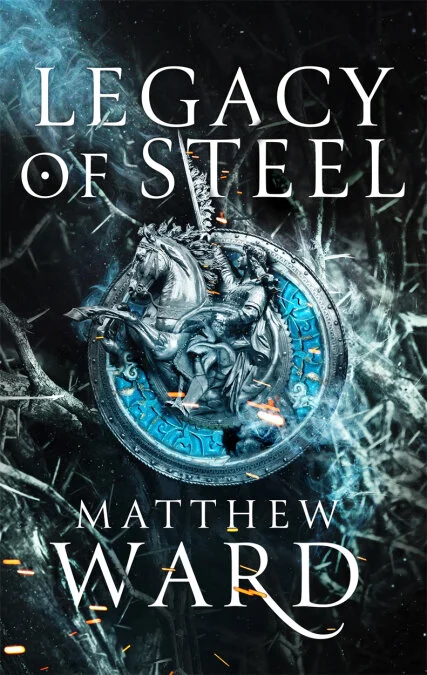
Legacy of Steel by Matthew Ward
I would like to thank Nazia from Orbit for an advance copy of this novel in exchange for a fair and honest review
Publisher – Orbit
Published - Out Now
Price – £25.00 Hardcover £9.99 Kindle eBook
A year has passed since an unlikely alliance saved the Tressian Republic from fire and darkness - at great cost. Thousands perished, and Viktor Akadra - the Republic's champion - has disappeared.
While the ruling council struggles to mend old wounds, other factions sense opportunity. The insidious Parliament of Crows schemes in the shadows, while to the east the Hadari Emperor gathers his armies. As turmoil spreads across the Republic, its ripples are felt in the realms of the divine.
War is coming . . . and this time the gods themselves will take sides.
The first act of the trilogy is like going up a hill on a rollercoaster; building anticipation for the journey and adventure ahead as you ascend the structure of the world the story gives you. For the second act all the momentum built up can be released as you now travel that world with characters you now know well - propelling you across the next part of the journey. Earlier this year I really enjoyed Legacy of Ash by Matthew Ward and I am very pleased to report that I think the sequel is even better expanding a tale of gods and mortals trying to battle for power across a very divided set of empires.
Following the aftermath of Legacy of Ash, the Tressian Empire has seen its corrupt leadership destroyed but also found it’s neighbouring enemy has started moves for war. The Gods and Goddesses of both sides have started to make appearances and a set of key characters are finding themselves with some form of immortal/magical support. One time revel Josiri Trelan is now a member of the new leading council (albeit not a well liked one) and is growing more concerned about the strange magical and dangerous criminal group known as the Crowmarket who are now coming out of the shadows and taking people for what appears to be sacrifices to their gods. Tressia’s best warrior the stern but noble Victor Akadra is missing in action having helped make a key victory possible against the power of the Dark – he is now living with someone we last saw dead. But on the borders of the two powers we also see Melanna daughter of the King of the Empire finally allowed to fight and sponsored by a Goddess while the Tressian warrior Rosa is learning to try to live with immortality and the horrors she faced in the first story. Each of these characters is about to find that their tales are connected and that the ancient powers of the world have decided they all play a key part in the future.
I love stories that build on consequences and all the changes of the first book drive the plot of the second. The learning curve of the first volume was very much focused on the borders of the Tressian Republic where Josiri fought an uneasy battle for independence – this allowed us to get to understand the various Tressian factions and the dynamics of the world. Magic was known but largely classed as religion. This time the story has truly gone epic and Ward isn’t afraid to show us far more of the world and characters than we’d seen previously. Three key plotlines are explored in the story in Tressia it’s the strange crime cult pf the Crowmarket they supported a move against one would be tyrant but now see Tressia as an opportunity to strengthen their power. Imagine a crime syndicate that can turns into ravens; have skilled assassins and some truly undead powers. These segments of the book are steeped in magic and a gothic feel as streets get misty and eerier. A key focus is on Josiri’s friend Malachi who made some high-risk decisions to save the Republic and now finds his alliances may have made him their prisoner. For those who enjoy the gothic and political intrigue these scenes will strongly appeal.
The second segment is a little more traditional as Hadari and Tressian armies finally meet. Prepare for battles of thousands of people as ancient strongholds and castles are besieged and destroyed. Ward has a great ability to give us a personal battle as we see characters make last stands, take on key warriors or attempt some unorthodox tactics and then can pull the reader’s eye back to se the wider battle ahead. I say semi-traditional because here we have key characters with magical abilities and happy to use their powers on each army in the form of avatars and monsters. On the Tressian side the fierce Rosa is determined to fight back against the invasion but is troubled that she has amazing powers of regeneration and cannot be killed by mortal means. This really makes her a fascinating character almost with a death wish and yet also juggling a developing relationship with Captain Sevaka the daughter of a tyrant who wants a fresh start. In all the war and bloodshed, I really appreciated the focus on the humanity of Rosa, and it invests us in her fate. Yet on the other side we don’t see the Hadari as true enemies helped by the focus on Melanna who someone is wanting to prove herself in an empire that has traditionally felt women have no place in battle. Her plotline is about reform and we actually see more of Hadari life in her segments making it clear this isn’t a truly evil enemy but that doesn’t mean ambitious politicians can’t be pulling strings.
This leads to a final thread running through both tales that of the Gods of the world taking a more active role. The Gods of this world are strange and not quite honest about their motivations. Three key ones to note are The God of the Dead known as The Raven who takes an active interest in Rosa’s tale and we this time explore the relationship with his eerier brother Jack o’Fellhallow; it’s is not a warm sibling rivalry as both sides get used as toys to settle a squabble. The more ambiguous is Ashana Goddess of the Moon who drives the Hadari attack, but we aren’t clear why she has taken such an active role to destroy Tressia. Again, Ward uses this to give the story a bigger scale and one where humans are pawns feeling the spirit s of the ancient myths of many worlds
With all these plates in the air it could be easy to fall into making this a very mechanical second act but what I think outs the Legacy series above a lot of epic fantasy series is the humanity of the characters (even Gods) and their inner turmoil, sacrifices and battles for survival make us invested in he tale. Ward throws a big focus on the wider cast in this tale and all the subplots are entertaining and have high stakes. What I enjoyed the most about the tale was often a middle volume feels just like the road to another destination. Legacy of Steel however is a huge tale in itself building successfully on the first novel but also giving you a compete tale of warring empires and gods that in some ways is resolved by the end with only a few plot threads dangled for the next book. Hugely enjoyable, extremely well executed and in terms of the roller coaster ride makes me very keen to see what happens on the next turn as we approach the grand finale. Strongly recommended for all epic fantasy fans.